
TL;DR
- Most sellers lose 3 to 5 percent of their FBA inventory without realizing it because manual auditing is slow, confusing, and easy to get wrong.
- Manual audits demand hours of cross-checking reports that update at different times, causing missed discrepancies and expired claim windows.
- FBA reimbursement services automatically scan 20+ discrepancy types, check claim eligibility, prepare documentation, and follow up until refunds are paid.
- Automated tools offer better accuracy, real-time detection, and scalability than any manual spreadsheet process, especially during Q4 and business growth.
- Sellers with larger catalogs, multiple marketplaces, or frequent inbound shipments benefit the most from automated reimbursement solutions.
- Manual auditing works only for very small sellers. Everyone else recovers more money and saves significant time by using a reimbursement service.
Here is a hard truth most Amazon sellers do not discover until it is too late: you are probably losing money right now and have no idea. Every year, 3 to 5% of FBA inventory is lost, damaged, or mishandled, yet most sellers assume Amazon has already taken care of it. The reality is very different.
Manual auditing sounds simple on paper, but once you start switching between adjustment reports, inbound logs, FC damage reports, and settlement reports, it becomes clear why so many discrepancies slip through unnoticed. The data never updates at the same time, reports contradict each other, and eligibility windows close before sellers even realize something is missing.
So the real question is, should you reconcile your FBA account? The real question is, how will you reconcile it without losing time, accuracy, or money?
This blog breaks down what is actually happening behind the scenes and why the FBA reimbursement service matters more than you think.
What manual auditing actually looks like for a seller
If you have ever tried doing FBA audits manually, you already know it is nothing like the step-by-step YouTube tutorials. In reality, sellers spend hours jumping between Adjustment Reports, Inbound Logs, FC Damage Reports, Removals, and Settlement Reports, each one updating at a different time and showing a different version of the truth.
You filter, download, re-download, match dates, cross-check quantities, and still feel like something is missing. Most sellers eventually realize the hardest part is not finding data but connecting it. A missing inbound unit could be sitting in a separate damage report. A lost inventory entry might show up only after reconciliation. And if you miss Amazon’s claim window by a few days, that money is gone.
Manual auditing turns into a spreadsheet marathon that eats hours every week. Even experienced sellers make common mistakes like misreading adjustment codes, overlooking discrepancies, or submitting claims too late.
This is exactly why many sellers switch to an FBA reimbursement service. It removes the guesswork, catches what humans miss, and frees up time to focus on growing the business instead of chasing numbers.
Where manual auditing fails?
Every seller who has ever tried to audit their own account knows the moment when reality hits. Manual checks sound manageable in theory, but in practice, they become a massive time drain.
During Q4 alone, most sellers spend 10 to 25 hours digging through reports instead of focusing on sales. And even with all that effort, Amazon’s data does not appear in real time. Many FBA reports lag 10 to 20 days, which means you are always chasing issues after the fact.
One mismatched SKU count or a missed Lost_FC entry can throw off your entire audit. Sellers often assume they are caught up, only to realize later that a key discrepancy never made it onto their spreadsheet. Even worse, many Amazon reimbursement claim opportunities disappear simply because they were not detected within Amazon’s eligible window.
This is where the cracks in manual auditing become expensive. You are not just losing time; you are losing money that should have been recovered through FBA reimbursements. And the frustrating part is that most of these losses happen silently, long before the seller even notices. For growing brands, manual audits eventually stop being sustainable. The business moves faster than spreadsheets ever can.
What do Amazon FBA reimbursement services actually do?
Most sellers hear about reimbursement tools and imagine something complicated or overly technical. In reality, the best Amazon seller reimbursement services are simply doing the work that sellers do not have time for, but with far more accuracy and consistency.
- Instead of manually digging through dozens of reports, these tools run continuous scans across 20+ discrepancy types.
- They automatically detect issues like Lost_FC, Damaged_FC, overages, shortages, and even those frustrating FC transfer losses that rarely show up in the main reports.
- The system pieces the data together, checks eligibility, and only highlights cases that Amazon will actually accept. This alone prevents sellers from wasting time on claims that would be rejected.
- Once a valid discrepancy is found, the service prepares claim-ready documentation using the exact format Amazon expects.
No guesswork, no back and forth, and no rewriting emails at midnight trying to match Amazon’s requirements. But the most underrated part is the follow-up. Good tools track every submitted case until the reimbursement hits your account.
Sellers often forget that Amazon does not always respond quickly, and without consistent follow-up, many cases simply stall. With automated checks, eligibility filtering, clean documentation, and active tracking, these services help sellers capture FBA reimbursements that would otherwise disappear. It is not just about automation; it is about giving sellers a level of accuracy and persistence that spreadsheets and manual checks can never match.
Compare both approaches based on what sellers actually care about
Sellers do not choose between manual auditing and reimbursement tools based on theory. They choose based on survival. When your catalog grows, returns rise, and inbound shipments pile up, you need a method that keeps up with Amazon’s pace, not one that depends entirely on your spare time.
#1 Accuracy
Manual auditing relies on experience. Even seasoned sellers miss trends, overlook Lost_FC patterns, or read adjustment codes incorrectly. The challenge isn’t effort; it is the scale of inventory flowing through Amazon. Professional Amazon seller reimbursement services use system-driven checks that flag inconsistencies humans can’t catch at scale. They trace patterns across dozens of shipments and instantly identify unusual gaps. For sellers who care about protecting margins, this accuracy becomes non-negotiable.
#2 Speed
Most sellers check reports weekly or monthly. By then, many eligibility windows for Amazon FBA refunds have already closed. Automated Amazon reimbursement services work in real time or with daily scans, meaning issues get detected while still claimable. This alone often doubles the number of successful claims for growing brands.
#3 Cost
Manual audits feel “free,” but the hidden cost is huge. Hours spent reconciling spreadsheets, chasing missing units, and submitting incorrect claims translate into lost revenue. With FBA seller reimbursement services, sellers pay only a percentage of the recovered money. No upfront fees, no risk, and no wasted hours. It is a cost structure sellers actually like because it earns only when they earn.
#4 Scalability
Everything breaks during growth or Q4. Manual auditing becomes impossible when sales spike, pallets go missing, and inbound shipments overlap. Automated Amazon reimbursement tools scale effortlessly. As your catalog expands, the system expands with it. No extra hours, no extra workload, just consistent recovery. For sellers serious about long-term profitability, accuracy, speed, cost efficiency, and scalability, automated auditing is a smarter investment.
Who benefits most from reimbursement services?
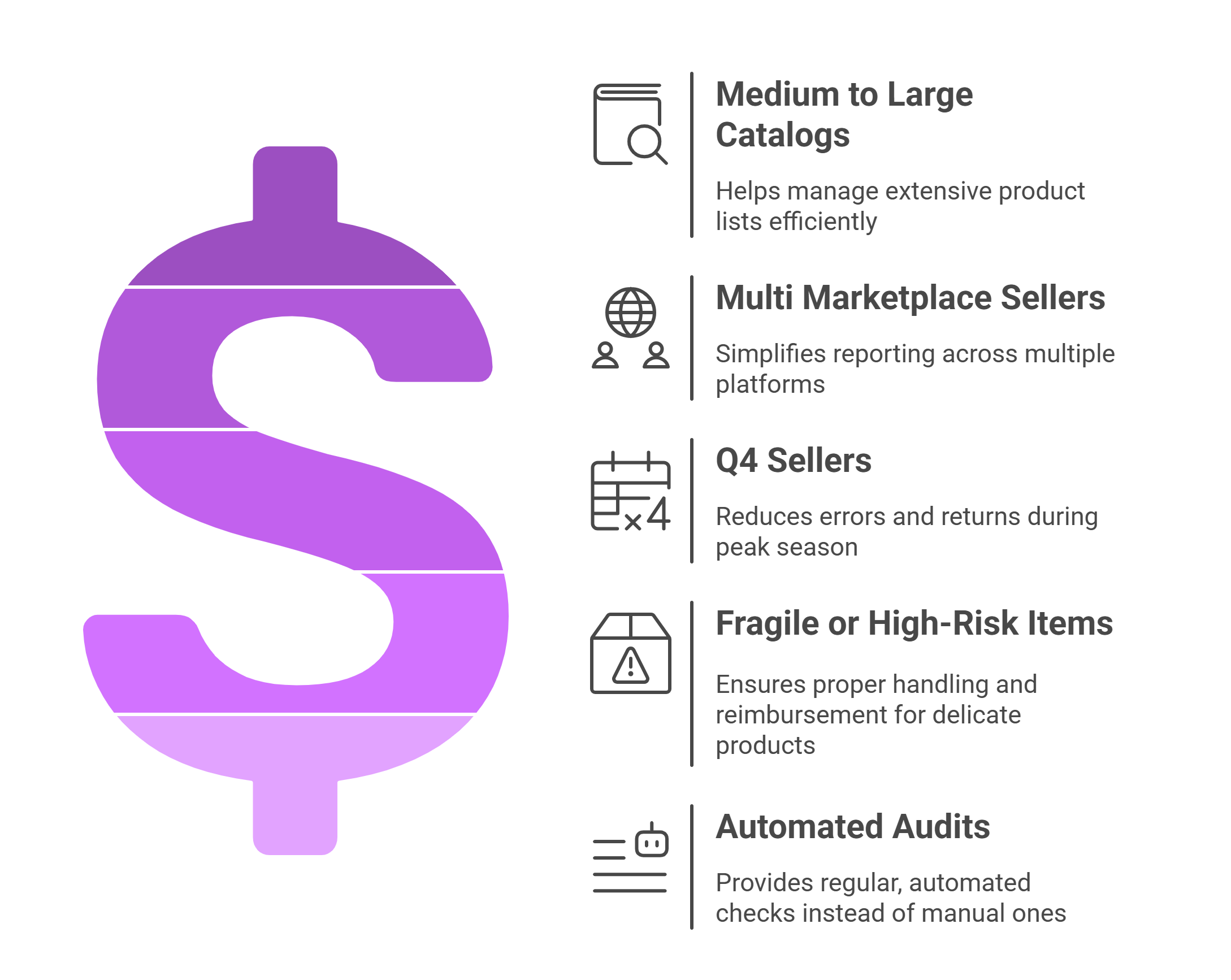
- Sellers with medium to large catalogs who struggle to track every inbound unit, adjustment, and discrepancy make automated recovery of FBA reimbursements far more effective.
- Multi-marketplace sellers (US, UK, DE, AU) are managing different reporting delays and error types across regions, where manual auditing becomes unrealistic.
- Q4 heavy sellers who face spikes in sales, returns, and warehouse errors, making real-time detection essential.
- Brands with frequent inbound shipments or fragile items like supplements, cosmetics, or home goods, where loss and damage rates are naturally higher.
- Sellers who cannot dedicate weekly hours to auditing and prefer automation to catch issues, file claims, and recover money without adding workload.
What to look for in a good reimbursement service?
Choosing the right reimbursement partner is not about finding the cheapest tool; it is about choosing a service that genuinely protects your money. Sellers want accuracy, transparency, and real support, not generic promises.
The first thing to check is a clear, honest fee structure. If a service earns only when you earn, the incentives are aligned. And most importantly, there should be no hidden fees for this essential first step in the reimbursement process. Start checking your inventory accuracy at no cost; no card is required.
The second thing that matters is manual case handling by experts. Amazon rejects poorly structured submissions all the time, so having specialists prepare and validate each case increases your success rate dramatically. A good service also gives you a clean dashboard with easy-to-scan discrepancy tracking, so you always know what was found, what is eligible, and what is already claimed. Security is non-negotiable. Any service you choose must offer a safe account connection and strict data protection.
How eStore Factory’s Amazon inventory reconciliation service helps sellers
This is exactly how our Amazon FBA Reimbursement Service and Amazon inventory reconciliation service operate. With our Amazon reimbursement software, Refunzo, you simply connect your Amazon account, and the system scans across 21 discrepancy criteria, identifying issues and giving you a real-time estimate of the Amazon FBA refunds owed to you.
From there, you choose your workflow. Use the detailed report to claim reimbursements yourself, or select the “Get us to do it” option, where our team prepares, logs, and follows up on every case until the refunds hit your bank. Every Amazon reimbursement claim receives personalized support, ensuring accuracy, faster resolutions, and maximum recovery. This is what a true reimbursement partner looks like.
Which is right for you?
Choosing between manual auditing and a reimbursement service really comes down to how your business operates today. If you want speed, accuracy, and stress-free FBA claims, a reimbursement service is the clear winner. It catches issues faster, files cleaner cases, and recovers more money with almost no effort from your side.
If you have a small catalog, minimal inbound shipments, and the time to audit reports every week, then manual auditing can still work. Just be ready to watch Amazon’s timelines closely and double-check every discrepancy yourself.
For everyone else, especially growing brands, the choice is simple. If you want to recover more while spending less time on manual checks, automated FBA reimbursement tools deliver the highest return with the least amount of work. Your time is valuable. Your reimbursements should be too.